
Ministry of Justice
Ministry of Justice: UX Research (Discovery, Beta,Live and beyond)
- Worked across multiple justice services, leading contextual research in prisons/custody and remote/lab studies with professionals and the public.
- Focused on reducing operational risk, improving completion and data quality, and getting services through GDS Live assessments.
- Projects included Prisoner Money (public + staff-facing), CCCD (Beta to Live), Cells Bells (Discovery), Moving People Safely (police integration), and Tax Tribunals (prototype testing).

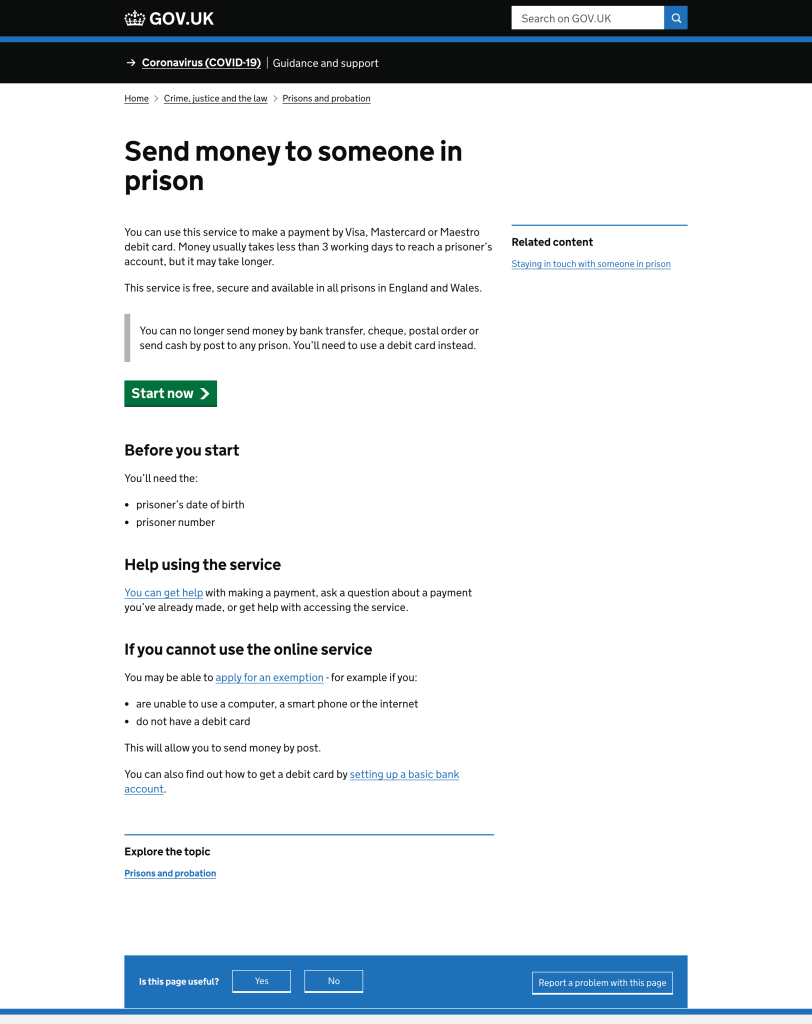
1) Send Money to Someone in Prison — Live GDS Assessment (27 Sept 2017)
Client / Sector: Ministry of Justice — Prison services
My role: UX Research (public + staff-facing)
Phase: Discovery/Beta → Live → post-live improvements
Problem
Sending money to prisoners was slow and stressful for families (previously cheque/cash/postal order/bring to prison; could take just over 2 weeks). Delays increased stress/anxiety and could create risk (e.g., bullying if funds were delayed).
What I did
- Conducted contextual research across 30+ prisons.
- Interviewed and tested with:
- “behind the wall” staff who process money (staff-facing service)
- intelligence/security staff monitoring payment security
- prisoners (before/after launch experience)
- members of the public at prison visitor centres
- Ran usability lab sessions with members of the public who had previously sent money to someone in prison (sessions of 6 participants).
- Monitored and synthesised customer queries after national rollout to identify recurring issues and opportunities to improve.
Key findings / decisions
- Service needed stronger contextual help and clearer guidance to meet government standards ahead of assessment.
- Post-live iterations were required based on real-world queries once the service went national.
Outputs
- Research findings and recommendations to inform design iterations
- Evidence to support GDS Service Assessment readiness (public-facing clarity/help)
- Post-live improvement backlog informed by customer queries
Outcome
Research directly drove design and implementation changes, including improvements specifically aimed at meeting GDS standards, enabling the service to pass Live assessment and continue improving after launch.person); synthesis; personas/journeys; prototype testing.
2) Claim for Crown Court Defence (CCCD) — Beta → Live GDS (29 Sept 2016)
Client / Sector: Ministry of Justice — Legal aid / justice payments
My role: UX Research (brought in during Beta to strengthen Live readiness)
Phase: Beta → Live (and mandated rollout)
Overview (from your notes)
- CCCD is a gateway transmitting an average of 270,000 crown court bills per year.
- Rolled out since mandated on 31 Oct 2017 with reported usage at 98%.
Problem
A Beta service existed, but needed stronger user evidence and targeted improvements to support Live GDS assessment and to ensure it aligned with how litigators/advocates actually work.
What I did
- Conducted 30+ interviews with litigators and advocates across the country (from sole practitioners to larger organisations).
- Interviewed caseworkers who submit claims on behalf of organisations; also interviewed Nottingham-based caseworkers using the Beta service to understand limitations.
- Combined workflow understanding (how they currently work) with observation of task completion (submitting claims) and fit to existing processes.
- Managed difficult recruitment constraints (no incentives permitted), relying on goodwill and clearly communicating the value of participation.
- Investigated assisted digital assumptions: tested feasibility of telephone support; confirmed primary users were digitally literate due to daily computer use.
- Addressed accessibility constraints by recruiting caseworkers with access needs (public service mirrored caseworker service).
Outputs
- Issue/severity insights from repeated user sessions
- Clear recommendations and iteration triggers (what to fix immediately vs monitor)
- Evidence base to strengthen Live assessment confidence
Outcome
Research identified and prioritised improvements, guiding iterations required for Live readiness and ongoing service refinement.
3) Moving People Safely — Police Integration Research (Beta)
Client / Sector: Ministry of Justice — Justice health/risk information transfer
My role: UX Research (brought in to cover previous researcher; focus on police use)
Phase: Beta
Problem
When people move between police, courts, prisons (and possibly hospitals), vital health/risk information and property details are captured on paper forms. This creates data quality risks and potential loss of information.
What I did
- Visited three police custody suites (Luton, Guildford, Maidenhead) and a Magistrates court.
- Observed end-to-end custody intake processes: what data is collected, where it’s recorded, who uses it, and what breaks.
- Mapped roles, tasks, systems, and handoffs — including interaction between police and third-party transport providers and onward transfer to courts.
- Fed findings back into the team’s existing courts/prisons solution so police needs could be integrated.
- Conducted further interviews with police to understand system variation across regions and implications for integration.
Outputs
- Evidence of how custody data and property logging flows through real operational contexts
- Integration requirements and constraints for joining police processes into courts/prisons service
- Research inputs to support a joined-up cross-organisation service model
Outcome
Provided the insight needed to design how police processes could integrate with an existing courts/prisons solution—supporting the aim of a joined-up service across police, courts, and prisons.
Assisted Digital + Accessibility (Send Money)
Problem → Some users couldn’t access digital service; accessibility needed formal assurance.
What I did → Prison questionnaire to 4 prisons (~500 responses) + visitor-centre feedback (50+), explored phone walkthrough/phone payments, charities/CAB/libraries, cards, PayPoint; acted as main contact with Digital Accessibility Centre and recruited people with access needs.
Outcome → Clear evidence of barriers + validated assisted-digital options and accessibility action points.
Digital Disbursements (Discovery → pilot)
Problem → Prisoners sending money out relied on slow/manual methods; staff sometimes had to physically go to post office for postal orders.
What I did → Visited 20+ prisons across categories/regions; mapped varied local processes; worked with service designers on flexible prototypes; iterated with stakeholders across staff roles.
Outcome → Service built and trialled in 22 prisons, with ongoing monitoring and issue resolution during pilot.
Cells Bells (Discovery)
Problem → Cell bell systems used for non-emergencies and emergencies; inconsistent assurance/testing across estate could affect response times and safety.
What I did → Prison-based research with staff and prisoners; collated findings across researchers; fed into stakeholder synthesis and report.
Outcome → Estate-wide insight + senior recommendations for improvements.
Tax Tribunals (Beta)
Problem → Need to validate whether users can complete appeal and payment journeys unaided.
What I did → Two rounds of lab testing (6 participants each), wrote screener, managed incentives/budget, planned sessions around iteration, wrote script/questionnaire, logged issues with severity.
Outcome → Implemented fixes between rounds (clarity on process, fees, tribunal independence, timescales, HMRC distinction) and re-tested.